A Notable Arrival in an Overlooked Corner of the State
Holmes County, Florida, is not a place where infrastructure investments typically make headlines. With a population of roughly 20,000 people spread across 489 square miles of timberland, farmland, and small towns in the Florida Panhandle, it is a rural county that has historically been bypassed by the kind of commercial development that characterizes Florida's coastal metros. It sits west of the Apalachicola River, along corridors that see plenty of through traffic but little of the investment that flows to Orlando, Tampa, or Miami.
For years, Holmes County has had almost no public EV charging infrastructure. This is not unusual. Rural counties across the United States have been systematically overlooked by major charging networks, which have concentrated their buildouts in metropolitan areas where EV adoption rates are highest and utilization is easiest to guarantee. As of early 2025, only 45 percent of rural counties nationwide had at least one fast charging port installed, compared to 76.5 percent of metropolitan counties. The pattern is consistent: infrastructure follows demand, and demand in rural areas has been slower to materialize.
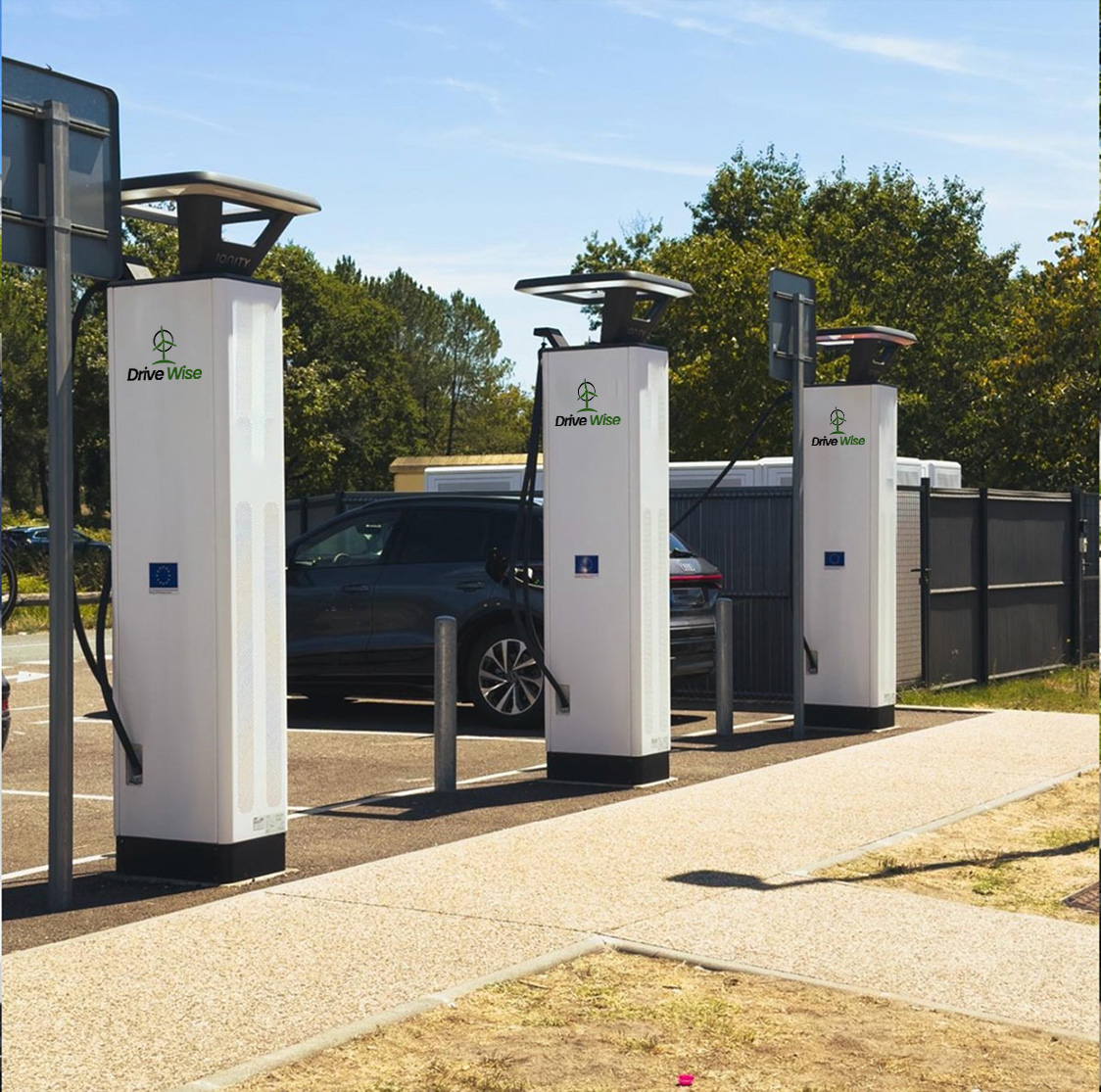
So when Drive Wise innovations installed six new EV charging stations across Holmes County, it was news worth noticing. Not because it was a massive deployment, but because it was a deliberate choice to build where almost nobody else was building, and because it was financed in a way that is still uncommon in the infrastructure world.
What the Six New Stations Mean for Holmes County and the Surrounding Region
The practical significance of this installation extends well beyond the county line. Holmes County sits at a crossroads of regional travel. Drivers heading west from Tallahassee toward the Florida Panhandle coast, or north into Alabama and Georgia, pass through this corridor. For EV owners, the absence of charging options in this stretch has long created a pocket of range anxiety, a gap in the regional charging network that effectively discouraged electric vehicle travel across a meaningful portion of the Florida Panhandle.
The six new stations change that equation. They serve local residents who have purchased EVs and previously had no reliable public charging option within the county. They serve travelers passing through, who can now plan routes through the Panhandle with greater confidence. And they serve the surrounding counties, Washington, Jackson, Calhoun, which have similarly limited charging infrastructure and which draw on any nearby stations to fill gaps in their own coverage.
In a state where Florida ranks second nationally in total EV registrations, with over 254,000 EVs registered and where EV purchases represented roughly 1 in 10 new vehicle sales in the fourth quarter of 2024, the demand for charging infrastructure is not theoretical. Yet the distribution of that infrastructure has been heavily skewed toward urban and suburban areas. Holmes County's new stations represent a small but meaningful step toward correcting that imbalance.
For the county itself, there is also a positioning benefit. Being an early adopter of EV infrastructure, relative to similarly rural counties in the Florida Panhandle, gives Holmes County a modest competitive advantage in attracting visitors, businesses, and residents who prioritize EV accessibility.
Why Rural Markets Are Becoming Attractive for EV Charging Investment
The decision to build in Holmes County is not charity. It is a calculated investment strategy that is becoming more common as the EV charging industry matures.
Rural and secondary markets offer several structural advantages that urban locations do not. Land costs are lower. Installation expenses, including permitting and utility connections, tend to be less burdensome. Competition is sparse. In a major metro like Orlando or Miami, a new charging station may be one of dozens within a few miles. In Holmes County, the six new stations may be the only reliable public option for many miles in any direction. That scarcity creates pricing power and utilization potential that urban stations, despite higher absolute traffic, often cannot match.
There is also a connective infrastructure role that rural stations play. They are not just serving local demand. They are filling gaps in the regional and interstate network, enabling long distance EV travel that would otherwise be impossible. This is why federal programs such as the National Electric Vehicle Infrastructure Formula Program have explicitly prioritized rural, underserved, and disadvantaged communities for charging infrastructure funding. Florida's own infrastructure deployment plan notes that 50 percent of the state's alternative fuel corridors are located in disadvantaged communities, and that NEVI funds are intended to fill gaps in rural and underserved areas.
For investors, the logic is straightforward. A charging station in an underserved rural corridor, installed before major networks arrive, can establish a first mover advantage that is difficult to replicate once the market is saturated.
How the Investment Model Works for This Installation
Drive Wise innovations financed the Holmes County installation through its fractional share ownership model. The company divided the project into a fixed number of equal ownership shares, which were made available to individual investors. Seventeen people purchased shares across the six new charging stations. Those investors co own the infrastructure without being involved in construction, maintenance, or daily operations. All of that is managed directly by Drive Wise innovations.
The model is designed to be passive. Drive Wise innovations handles site selection, permitting, installation, ongoing maintenance, insurance, and the operational management of the stations. Investors are not involved in day to day decisions, maintenance calls, or customer service. They own a share of a physical asset and collect a portion of the revenue it generates, after Drive Wise innovations deducts its management and maintenance fee.
This structure is particularly well suited to a project like the Holmes County installation, where the upfront capital requirement for a single investor to build and operate six charging stations would be prohibitive. By pooling capital from multiple shareholders, the project becomes accessible to individuals who want direct infrastructure exposure without the operational burden or the capital intensity of full ownership.
How the 17 Shareholders Are Now Earning Passive Income
As the six charging stations begin generating revenue from EV drivers using them, that revenue is distributed monthly to the 17 shareholders in proportion to the number of shares each person holds. Income begins flowing to investors without any further effort or involvement on their part.
This is the fractional infrastructure ownership model functioning as intended. The shareholders do not manage the stations. They do not handle customer complaints, equipment failures, or utility negotiations. They own a piece of a physical asset, and they collect a share of the revenue it produces. It is a structure that mirrors, in some ways, how real estate investment trusts operate, but applied to a newer asset class with a different risk profile and a different stage of market maturity.
The monthly distribution model is also notable. Unlike equity investments in publicly traded companies, where returns depend on stock price appreciation and dividends that may be irregular or nonexistent, this model produces a predictable income stream tied directly to the utilization of the physical asset. For investors who value recurring cash flow over speculative appreciation, that structure has clear appeal.
Why This Particular Installation Favors Early Investors
From an investment standpoint, the Holmes County project has several characteristics that make it an interesting case.
First, it is early. In a county with almost no existing public charging infrastructure, the six new stations are likely to capture a high share of whatever EV charging demand exists in the region. There is no established competitor to siphon off customers. For travelers passing through, these stations may be the only viable option within a wide radius, which drives utilization.
Second, the regional demand is growing. Florida's EV registration numbers have surged, with the state ranking second nationally behind California. Central Florida alone saw EV registrations grow 15.2 percent in 2024, and Orange County registrations surged 46 percent year over year. While the Panhandle lags the central and southern parts of the state in absolute EV density, the directional trend is the same. As EV adoption spreads outward from major metros, rural counties like Holmes will see their local and pass through demand increase.
Third, the long term nature of the EV transition benefits early infrastructure in underserved areas. This is not a cyclical trend. Automaker commitments, battery cost declines, and shifting consumer preferences are pushing in the same direction for decades. A station installed today in a rural gap will likely see its utilization curve rise steadily as the vehicle fleet electrifies, rather than peaking and declining.
Fourth, the lower competition and lower land costs in rural markets mean that the break even utilization threshold for a station can be lower than in saturated urban markets, where high rents and intense competition compress margins.
Florida and the Southeast: The Broader Context
Florida is an unusual case in the national EV landscape. It is a politically conservative state with no state incentives for EV purchases, yet it ranks second in the nation for total EV registrations. The growth has been driven not by policy mandates but by consumer enthusiasm, favorable climate conditions for battery performance, and electricity prices that are roughly 2.5 times lower than gasoline costs.
The state's charging infrastructure, however, has not kept pace. Florida has approximately 19 EVs for every public charging port, a ratio that indicates significant undersupply relative to demand. The state has received substantial federal NEVI funding to address this gap, with a focus on rural and underserved corridors.
Across the southeastern United States, the pattern is similar. EV adoption is growing, but charging infrastructure in rural and secondary markets remains thin. This creates a window for private operators willing to build ahead of the curve in places that major networks have not yet prioritized.
Where This Fits in Drive Wise innovations's Wider Operations
The Holmes County installation is not an isolated project. Drive Wise innovations operates both EV charging stations and commercial wind turbines, using the same fractional ownership model across both asset classes. The company manages the full lifecycle of each asset, from development through operations, while investors hold passive ownership shares and receive monthly distributions.
This dual focus on renewable energy and EV infrastructure places the company in the middle of two major structural transitions in the energy and transportation sectors. The Holmes County charging stations are one node in a broader network the company is building, but they are notable for being in a location that most infrastructure investors would have passed over.
The Balanced View: Risks and Considerations
No investment in early stage infrastructure is without risk, and the Holmes County project is no exception.
The most significant risk is dependency on continued regional EV adoption. If EV sales in the Florida Panhandle slow, or if the area's population and traffic patterns shift unfavorably, utilization rates may not meet projections. Rural EV infrastructure is a bet on the direction of travel, not a guarantee.
Consistent traffic and usage are essential. Six charging stations in a rural corridor depend on a steady flow of vehicles, both local and pass through. If regional travel patterns change, or if competing stations are built nearby, the revenue model could be pressured.
The asset class itself is young. Unlike real estate, which has centuries of performance data, or even urban charging networks, which have been operating for over a decade, rural EV charging infrastructure as an investable asset has limited historical track record. The 17 shareholders in Holmes County are relying on projections and analogies, not on decades of proven returns.
Utility costs are another variable. Electricity pricing, demand charges, and grid capacity can all affect station profitability in ways that are difficult to predict at the time of investment.
What This Could Mean for Overlooked Counties Nationwide
The Holmes County installation is a small project in a small county. Six chargers and 17 shareholders will not transform the national EV infrastructure landscape. But it is representative of a larger trend that could reshape both EV infrastructure development and investment access in the coming years.
As major charging networks continue to focus on high density urban and suburban markets, a significant gap remains in rural and secondary counties across the United States. That gap represents both a public policy challenge and a private investment opportunity. Companies and platforms that are willing to build in these overlooked areas, and to structure their projects so that individual investors can participate, may find themselves positioned advantageously as the EV transition broadens beyond its current urban core.
For counties like Holmes, the arrival of charging infrastructure is a modest but meaningful step toward connectivity, economic resilience, and participation in a national transition that has largely passed them by. For the 17 shareholders, it is a chance to own a piece of infrastructure in a market that is early, underserved, and structurally aligned with a multi decade growth trend.
Whether that alignment translates into the returns that investors hope for will depend on execution, timing, and the pace of EV adoption in places that have historically been last to receive new infrastructure. The stations are built. The shares have been sold. The revenue has begun to flow. Now the market will determine what this experiment in fractional rural infrastructure ownership is worth.